60% of GCCs lack integrated commute systems despite rising ESG, safety focus: Routematic report
NEW DELHI: Routematic, in partnership with Research NXT, has released a new report highlighting significant gaps in corporate commute management across India’s Global Capability Centres (GCCs).
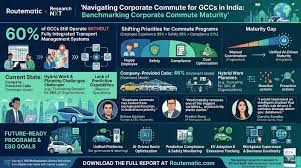
Titled “Navigating Corporate Commute for GCCs in India: Benchmarking Corporate Commute Maturity,” the study finds that 60% of GCCs still operate without fully integrated transport management systems, relying on fragmented or manual processes.
Key findings
The report underscores a shift in priorities, with employee experience emerging as the top focus (35%), ahead of safety (26%), compliance (21%), and cost optimisation (18%).
Company-provided cabs remain the dominant mode of transport, accounting for 46% of employee commutes, while hybrid work has added complexity, with 36% of organisations reporting fluctuating daily demand.
The study also reveals that predictive, data-driven commute systems are largely absent, leaving most operations reactive rather than proactive.
Challenges and evolving priorities
Key challenges faced by organisations include vendor performance issues, budget constraints, and employee dissatisfaction in managing large-scale mobility programs.
Sriram Kannan said that as GCCs evolve into strategic hubs, employee commute is becoming a boardroom priority, directly impacting productivity, safety, and experience.
Future-ready mobility systems
The report outlines a maturity roadmap for GCC commute programs, emphasising the transition from manual systems to AI-driven, predictive mobility platforms.
Future-ready solutions will focus on unified transport platforms, predictive compliance and safety monitoring, AI-led route optimisation, and integration of EVs with emissions tracking to meet ESG goals.
Insights from industry leaders, including Protick Basu and Garvita Sandhu, highlight the need for automation, intelligent systems, and improved verification mechanisms to enhance operational efficiency.
The report covers major GCC hubs such as Bengaluru, Hyderabad, Pune, Chennai, Mumbai, and Delhi-NCR, offering a comprehensive view of commute efficiency, scale, and sustainability readiness.