Fibershot C-8 vs traditional OTDRs: Star Infomatic drives the shift to converged testing
NEW DELHI: For decades, Optical Time Domain Reflectometers (OTDRs) have been the backbone of fiber network deployment and maintenance. While traditional OTDRs continue to deliver reliable optical diagnostics, today’s converged network environments demand far more than fiber testing alone. Field engineers are now expected to validate optical links, commission enterprise networks, and configure surveillance systems—often within a single site visit. This changing operational landscape is driving interest in multi-function platforms such as the Fibershot C-8, recently launched by Star Infomatic.
Scope of Functionality: Single-Purpose vs Multi-Domain
Traditional OTDRs are purpose-built instruments focused exclusively on fiber fault analysis. They perform reliably when identifying breaks, splices, reflections, and attenuation, but require engineers to carry additional tools once fiber validation is complete.
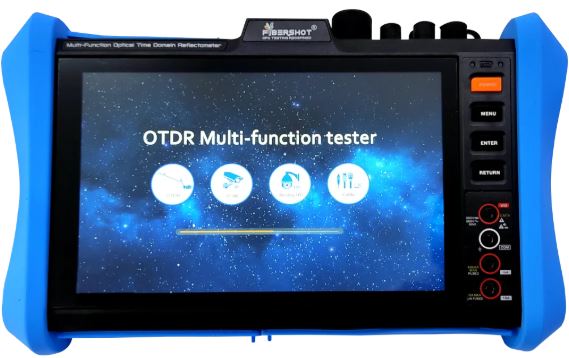
The Fibershot C-8 Multi-Function OTDR, launched by Star Infomatic, expands this scope by combining dual-wavelength OTDR testing (1310 nm / 1550 nm) with Gigabit Ethernet testing, SFP module analysis, copper cable diagnostics, and surveillance camera testing in a single handheld device.
Impact: Fewer tools in the field and reduced operational complexity.
User Experience and Field Workflow
Most traditional OTDRs rely on button-driven interfaces and proprietary software. While accurate, they often require extensive training and offer limited flexibility for configuration beyond optical testing.
The Fibershot C-8 introduces an Android-based operating system with an 8-inch high-definition touchscreen, allowing technicians to handle testing, configuration, and diagnostics directly from the device. Web access, PoE configuration, and real-time validation can be performed on-site without external equipment.
Impact: Faster workflows and reduced learning curves for field teams.
Deployment Speed and First-Time-Right Outcomes
In conventional deployments, OTDR testing is only one step in a multi-tool process. Separate devices are needed to test LAN connectivity, power PoE equipment, and configure cameras—often increasing installation time and the risk of missed issues.
By contrast, the Fibershot C-8 enables fiber testing, Ethernet validation, PoE powering, and camera configuration within a unified workflow. This integration improves first-time-right outcomes and shortens commissioning cycles.
Impact: Improved SLA adherence and quicker service activation.
Surveillance and Smart Infrastructure Readiness
Traditional OTDRs are not designed to support surveillance deployments, despite CCTV and IP cameras becoming standard components of modern networks.
The Fibershot C-8 addresses this requirement with IP and coax camera testing, live video preview, H.265 decoding, PoE output, and on-site camera configuration—making it well-suited for smart cities, transport infrastructure, industrial sites, and enterprise security networks.
Impact: One device supporting both network and surveillance installations.
Cost and Operational Efficiency
While traditional OTDRs may appear cost-effective initially, their single-purpose nature often leads to higher operational costs due to multiple tools, extended site visits, and additional manpower.
By consolidating functions into a single platform, the Fibershot C-8—introduced by Star Infomatic—helps organisations reduce equipment overlap, optimise field resources, and improve overall return on investment across large and distributed deployments.
Impact: Lower total cost of ownership over the project lifecycle.
Conclusion: Evolution, Not Replacement
Traditional OTDRs continue to serve an important role in pure fiber diagnostics. However, as networks converge across fiber, LAN, and surveillance domains, their limitations become increasingly evident. The Fibershot C-8 Multi-Function OTDR, launched by Star Infomatic, represents an evolution in field testing—extending beyond optical measurement to meet the practical demands of modern network deployments.
Rather than replacing legacy OTDRs, platforms like the Fibershot C-8 redefine how field engineers work—prioritising speed, accuracy, and operational efficiency in a single, integrated solution.