India’s AI innovations take centre stage at UNGA week
NEW DELHI: India’s experience in using artificial intelligence, digital public infrastructure and technology-led solutions for inclusive development took centre stage at the fifth edition of ‘India Day @ UNGA’, held during the week of the 81st United Nations General Assembly.
Organised by Reliance Foundation, the United Nations in India and the Observer Research Foundation (ORF) on September 24, the event brought together government representatives, multilateral institutions, civil society organisations and private-sector leaders to discuss how development innovations emerging from India can be adapted and scaled across the Global South and other regions.
With the international community approaching the 2030 deadline for the Sustainable Development Goals, discussions at the event focused on finding scalable approaches to development amid geopolitical tensions, climate challenges and rapid technological change. AI and digital infrastructure emerged as common themes across the discussions, particularly in relation to public service delivery, healthcare, education and economic opportunity.
A high-level ministerial conversation titled ‘Ruptures & Ramparts: Building Bridges for a Changing World’ examined how governments and institutions can develop new models of international cooperation in response to technological, climate and geopolitical disruptions. The session featured External Affairs Minister S Jaishankar, Jamaica’s Foreign Affairs and Foreign Trade Minister Kamina Johnson Smith, Suriname’s Foreign Affairs, International Business and Cooperation Minister Melvin Bouva, Ghana’s Foreign Affairs Minister Samuel Okudzeto Ablakwa, and Celeste Connors, President and Chief Executive of the East-West Center in the United States.
Speaking at the session, Jaishankar highlighted the role of multilateral institutions and cooperation in addressing emerging global challenges. He also referred to the role of BRICS in bringing issues such as sustainability and cooperation into discussions around the United Nations system.
Ghana’s Foreign Affairs Minister Samuel Okudzeto Ablakwa called for greater equality in international partnerships, saying developing countries should have the flexibility to engage with different partners and secure outcomes that serve their interests.
The event also highlighted India's approach to deploying technology at population scale. Rohit Kansal, Secretary, Department of Rural Development, said the significance of India's digital and physical infrastructure lies in its ability to democratise access and enable wider participation in development. He also stressed the importance of developing AI systems that can interact effectively with people across different languages and contexts.
Healthcare was another major focus of the discussions. Punya Salila Srivastava, Secretary, Ministry of Health and Family Welfare, underlined the need to combine physical infrastructure with digital technologies and AI to strengthen health systems and improve outcomes.
The role of AI in the energy sector was also discussed. Santosh Kumar Sarangi, Secretary, Ministry of New and Renewable Energy, said AI could contribute to making energy infrastructure more resilient and improving the efficiency of power distribution systems as demand for computing and digital technologies expands.
B Srinivasan, Executive Lead, Reliance Foundation, said the scale and complexity of contemporary development challenges require greater cooperation between governments, institutions and communities. He emphasised the role of collaboration, technology and human-centred approaches in shaping future development models.
Stefan Priesner, United Nations Resident Coordinator in India, said the remaining years before 2030 provide an opportunity to take proven development solutions from India to other countries. He highlighted the potential of adapting innovations developed in India to meet the needs of households and communities elsewhere.
The event also featured remarks by Vishal Harsh, Deputy Consul General, Consulate General of India, who highlighted the relevance of India's experience for countries seeking scalable development solutions. He said technologies and innovations developed at population scale could offer useful models for countries across the Global South.
Samir Saran, President, ORF, said India Day was designed around the broader objective of exploring how technology, innovation, philanthropy and international institutions can work together to address human development challenges. He described AI as a broader societal and development issue rather than solely a technological one.
Four thematic sessions during the programme examined the future of development and the role of emerging technologies. ‘Beyond 2030: Rewiring Development for an Age of Intelligence, Inclusion and Instability’ explored the impact of geopolitical, climate, demographic and technological changes on development strategies.
The session ‘Women, Children and Youth: Building Healthier Futures for the Next Billion’ focused on healthcare, education and economic opportunities, with discussions around public systems, community-led approaches, technology and partnerships.
AI's potential for large-scale deployment was examined during ‘The AI Promise: Diffusion at Population Scale’, which looked at the use of artificial intelligence across languages, sectors, institutions and public-service systems in India and other developing economies.
Another session, ‘Rules of Engagement: AI Governance for a Changing World’, focused on AI regulation, data governance, institutional capacity and responsible deployment of emerging technologies.
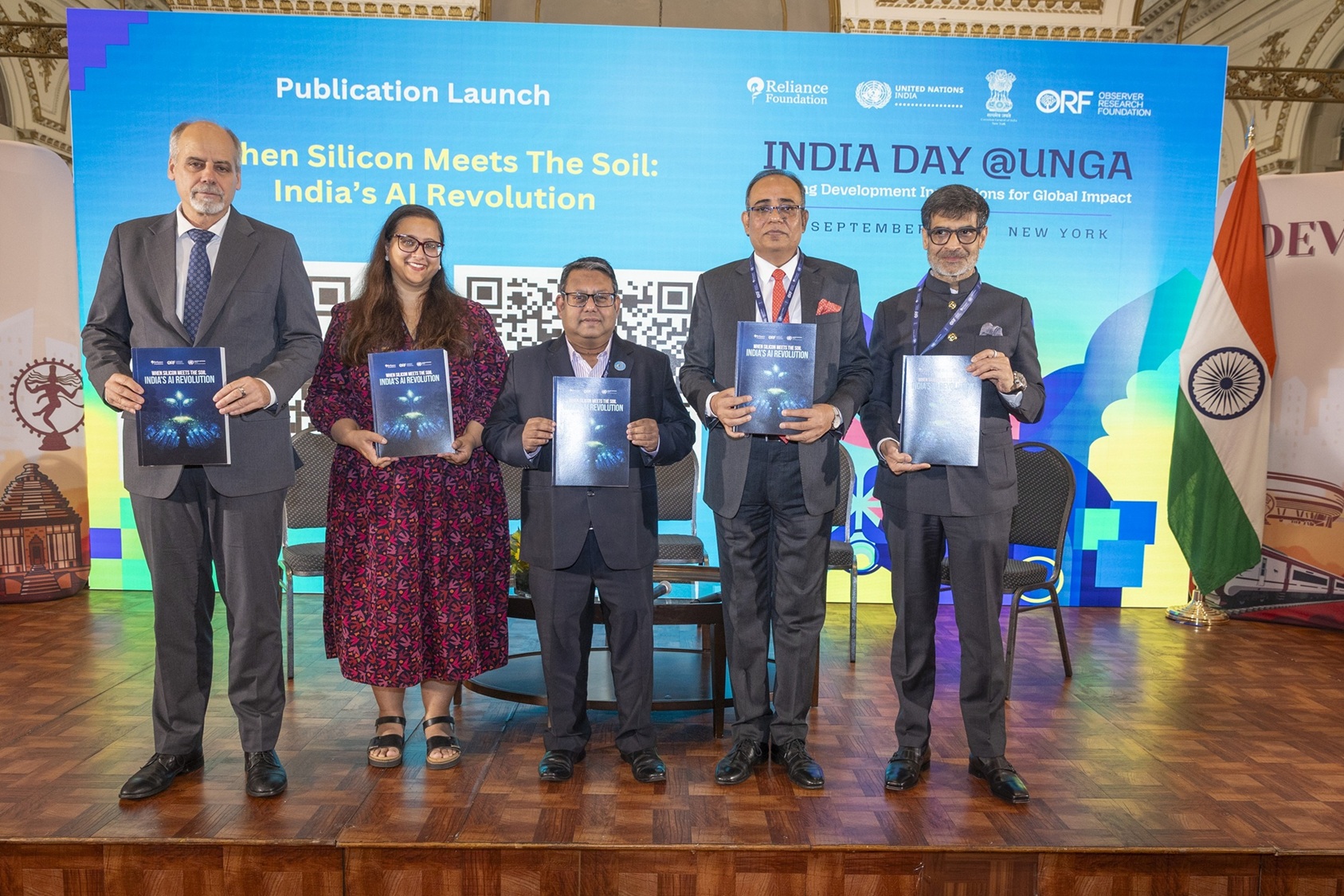
The fifth edition of India Day @ UNGA also saw the launch of a special publication titled ‘When Silicon Meets the Soil: India's AI Revolution’. The publication examines India's experience in applying artificial intelligence to real-world challenges and explores the country's emerging position as a major source of AI use cases. It brings together 18 chapters covering different aspects of India's AI ecosystem.
Since its launch in 2022, India Day @ UNGA has provided a platform for discussions around India's development experience and the potential for its innovations to be adapted internationally. The 2026 edition placed particular emphasis on the intersection of AI, digital public infrastructure, health, women-led development and inclusive growth.
The discussions at this year's event reflected a broader focus on how development solutions can move from local implementation to population-scale deployment. Organisers said the objective was to explore models of cooperation that can support social development in the Global South while contributing to wider international efforts to advance the Sustainable Development Goals.