China-Taiwan tensions deepen over World War II historical narrative
NEW DELHI: China and Taiwan have become embroiled in a fresh dispute over the historical interpretation of World War II, with Beijing accusing Taipei of challenging and distorting China’s official account of the country’s resistance against Japan. The dispute has gained prominence following recent remarks by Chinese President Xi Jinping during his meeting with US President Donald Trump in Washington, where the two leaders highlighted the wartime alliance between the United States and China.
China’s government on Wednesday accused Taiwan of “desecrating the martyrs” by questioning Beijing’s interpretation of the war. Chinese authorities said attempts to challenge the country’s established narrative amounted to a betrayal of history, underscoring the political and emotional importance Beijing attaches to the legacy of the conflict, in which millions of Chinese people died during Japan’s invasion.
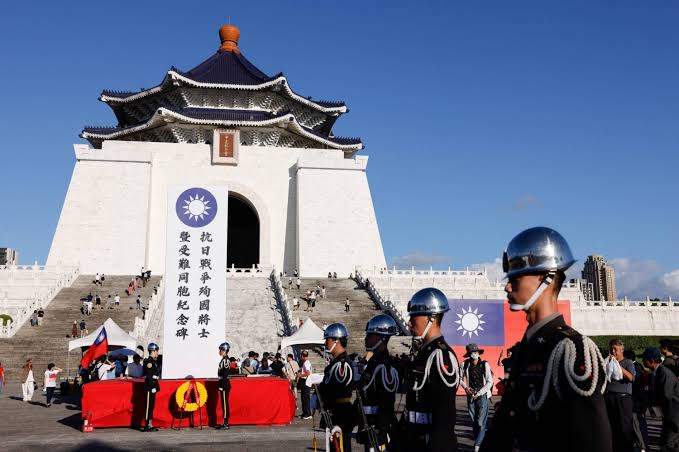
At the centre of the dispute is the question of which Chinese government should be associated with the country’s wartime alliance with the United States. Taiwan points out that the Republic of China (ROC) was the government representing China during World War II and fought Japan alongside the Allied powers. The People’s Republic of China (PRC) was established only in 1949, four years after the war ended. The ROC government subsequently moved to Taiwan following the Chinese civil war and continues to use the name Republic of China.
Taipei has objected to Beijing’s increasing emphasis on the role of the Communist forces in China’s wartime resistance. Beijing’s official historical narrative describes Communist guerrilla forces as the “backbone” of the resistance, while Taiwan argues that this portrayal gives insufficient recognition to the ROC government and its military forces, which fought Japan during the conflict.
The issue received renewed attention after Xi and Trump referred to the wartime cooperation between the United States and China during their recent Washington summit. A White House fact sheet said the two countries were allies during World War II and fought side by side, without specifying that the Chinese government at the time was the ROC. Taiwan subsequently expressed concern that such wording could reinforce Beijing’s preferred interpretation of the historical record.
Taiwan’s Mainland Affairs Council has argued that the ROC’s role should be explicitly recognised when discussing the US-China wartime alliance. Taiwanese officials have said Taipei will continue communicating its position to Washington, stressing that the ROC was the Chinese government that maintained the alliance with the United States throughout World War II.
The controversy also has a wider diplomatic dimension. Taiwan is concerned that Beijing’s presentation of World War II history could influence how the United States and other countries understand the historical relationship between China, Taiwan and the United States. Analysts in Taiwan have noted that historical language used by major powers at high-level diplomatic events can become part of the broader international narrative over time.
The issue is particularly sensitive because the history of World War II remains closely connected to contemporary relations between China, Taiwan, Japan and the United States. China continues to place strong emphasis on Japan’s wartime actions, while Taiwan has its own complex historical experience, having been under Japanese colonial rule from 1895 to 1945. Different political groups within Taiwan also hold differing views about how the island's history should be presented in relation to China.
Taiwan’s ruling Democratic Progressive Party has traditionally placed greater emphasis on Taiwan’s distinct historical and political identity. The opposition Kuomintang (KMT), meanwhile, governed the Republic of China during World War II and has argued that the ROC’s wartime role should be properly recognised. The KMT has also criticised the current Taiwan government over what it describes as selective references to ROC history in its dispute with Beijing.
The latest dispute therefore goes beyond a disagreement over historical terminology. It reflects competing interpretations of the political history of China and Taiwan and comes at a time when relations across the Taiwan Strait remain a major issue in US-China relations. China regards Taiwan as part of its territory, while Taiwan is governed separately under its own authorities. Beijing has repeatedly described the Taiwan issue as one of its most sensitive diplomatic concerns.
For now, the historical dispute has not been accompanied by any reported change in Washington’s Taiwan policy. However, Taiwanese analysts have warned that repeated references to World War II in high-level US-China diplomacy could shape international perceptions of the historical roles of the ROC and PRC.