IMC 2026: Global telecom leaders say AI-native networks and 6G will shape future connectivity
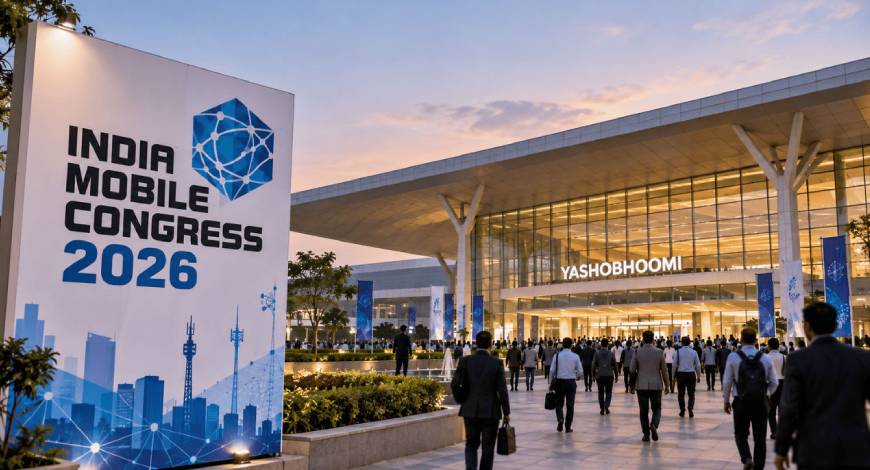
NEW DELHI:Global technology leaders, telecom operators and policymakers at the 10th edition of India Mobile Congress (IMC) 2026 have emphasised that the future of telecommunications will depend on AI-native networks, intelligent infrastructure and the development of globally harmonised 6G standards.
Held at Yashobhoomi under the theme “Scale Without Boundaries”, the event highlighted a shift in the telecom industry's priorities from expanding connectivity to integrating artificial intelligence into networks, improving customer experience and enabling new industrial applications.
Andres Vicente, CEO for South-East Asia, Oceania and India at Ericsson, said India's rapid 5G adoption and continued investment in advanced networks had laid a strong foundation for the next phase of digital growth. He said the transition to 5G Standalone would make networks more programmable and support differentiated connectivity, paving the way for AI-driven applications and the eventual evolution towards 6G.
Vivek Badrinath, Director General of the GSMA, said India had established strong digital foundations through its large connected population, technology ecosystem and talent pool. He said the next challenge was to unlock greater economic and social value from connectivity by strengthening computing infrastructure, AI models, data capabilities and skills, alongside more intelligent and programmable networks.
Qualcomm's ISAG Chair, Etienne Chaponniere, highlighted the growing role of on-device AI, saying future devices would need to process more information locally rather than transferring all data to cloud infrastructure. Such an approach could reduce demands on network bandwidth, computing resources and power while influencing the design and standardisation of future networks.
Ericsson Senior Vice President and Group CTO Erik Ekudden said the expansion of AI into industrial environments and mission-critical applications would require networks that are more intelligent, programmable and context-aware. He highlighted the concept of an “intelligent fabric” that integrates connectivity, cloud, edge computing and AI to deliver the required network performance and latency.
Giacomo Robustelli, Head of European Affairs and Economic Studies at TIM, described AI as both a software and an infrastructure revolution. He said the expansion of AI applications would require corresponding growth in connectivity, computing, data centres, storage and cybersecurity, adding that trust would be essential to scaling intelligent services.
On the development of 6G, N. G. Subramaniam, Chairman of the Bharat 6G Alliance, said the technology would go beyond faster speeds to enable more intelligent connectivity and new industrial opportunities. He noted that India's 6G development efforts were progressing with government support and industry participation in research and innovation.
Dr Youn Sun Kim, 3GPP RAN Chair at Samsung Korea, stressed the need for globally harmonised 6G standards that accommodate different regional requirements and operator needs. Key areas under consideration include energy efficiency, spectrum utilisation, coverage, diverse device types and the integration of terrestrial and non-terrestrial networks.
Reliance Jio President and Group CTO for Mobility Shyam Prabhakar Mardikar said the convergence of computing and connectivity would redefine the role of telecom operators. He said 6G should focus not only on capacity and coverage but also on delivering personalised insights, knowledge and intuitive digital experiences.
Discussions also focused on network automation, service reliability and customer experience. Reliance Jio President for Regulatory Policy U.K. Srivastava said zero-touch networks and predictive maintenance could help telecom operators identify problems early, reduce service disruptions and improve operational efficiency at scale.
Bharti Airtel's Nirmesh Yadav said quality of experience would be a major driver of 5G monetisation. He noted that consumers were more concerned about uninterrupted video calls and reliable digital services than headline network speeds, requiring greater coordination among stakeholders across the service delivery chain.
Dr Rajkumar Upadhyay, CEO of C-DOT, called for India to move beyond manufacturing towards greater value creation through indigenous design, intellectual property and domestically developed telecom equipment. He highlighted the role of production-linked incentive schemes and startups while underlining the importance of quality, security, AI and cybersecurity.
Globe Philippines CEO Carl Cruz said the industry's focus needed to shift towards the value connectivity creates for consumers and businesses. He identified simplicity, trust and participation in the digital economy as increasingly important measures of the customer experience.
The role of AI in industrial operations and enterprise transformation also featured prominently. Ericsson Vice President and Head of Global AI Accelerator Elena Fersman said AI systems operating within factories and telecom networks would increasingly need to understand each other's intent and interact seamlessly.
Archana Vemulapalli, Partner and Global Head of AI Product Management and Strategic Relations at Goldman Sachs, said organisations would need to build the agility to adopt AI responsibly, simplify decision-making and align implementation with business outcomes.
Sandeep Agrawal, Head of Products and Platforms for Network Solutions and Services at TCS, highlighted the growing complexity of telecom networks as they evolve towards intelligent radio access networks. He said neutral system integrators would become increasingly important in ensuring interoperability among multiple vendors, software platforms and technologies.
The discussions at IMC 2026 underscored a common industry view that the next phase of telecommunications will be shaped by the convergence of AI, computing and connectivity. The transition towards intelligent networks and 6G is expected to create new opportunities for industrial innovation, digital services and India's role in the global telecommunications ecosystem.

.jpeg)